
Louvre Roof vs Retractable Fabric Pergola: Which Is Right for Your Garden?
Once you decide to invest in a permanent pergola rather than a parasol or folding awning, your biggest design choice sits directly overhead. Modern architectural shading systems largely divide into two distinct engineering approaches. You can choose an adjustable aluminium louvre roof, or you can opt for a retractable fabric roof pergola.
On paper, both options create a sheltered outdoor living area over a patio, dining terrace or garden lounge. In everyday use, however, they behave quite differently. They change how daylight reaches your patio and ground-floor rooms, how much open sky you see when the weather turns fine, how rain is managed and how the finished structure sits against your home.
Comparing a louvre roof vs retractable pergola system comes down to how you want your garden to feel across different seasons and times of day. Both designs sit at the premium end of outdoor living, and each solves a different set of architectural and practical priorities.
What Is a Louvre Roof Pergola?
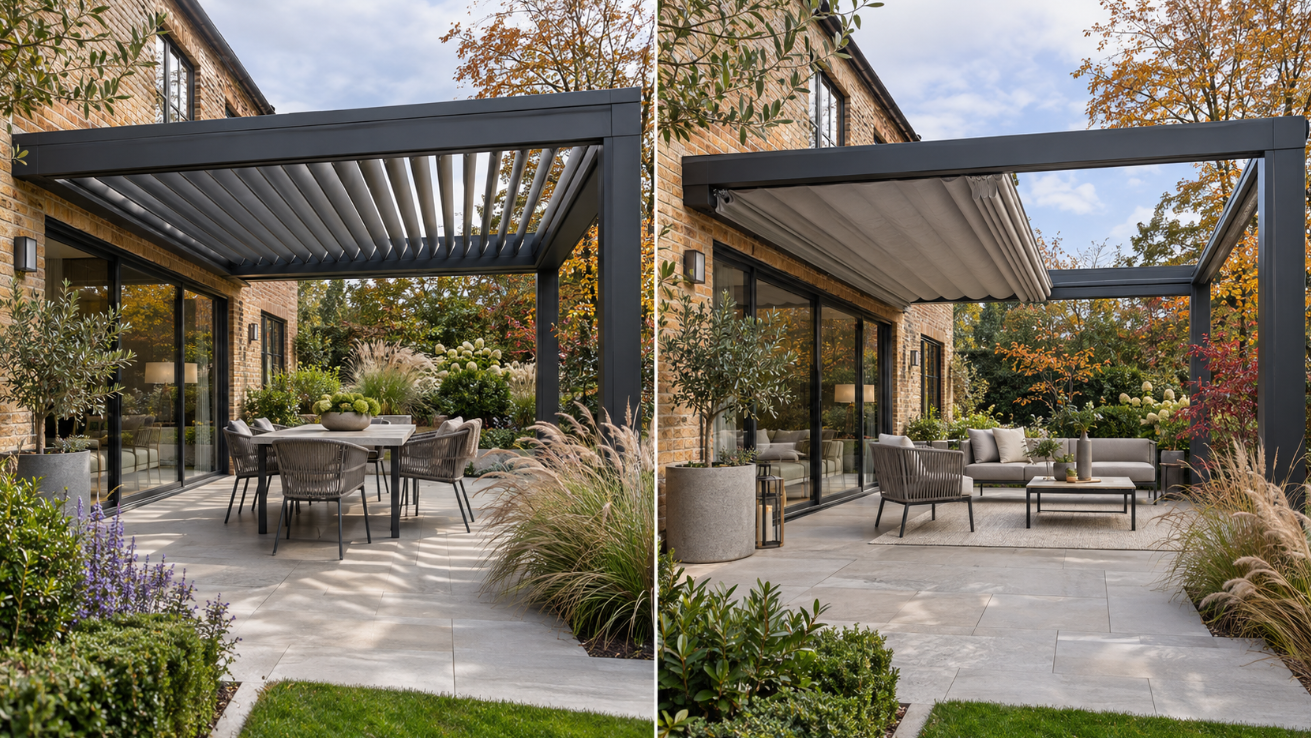
A louvred pergola uses extruded aluminium blades set within a rigid perimeter frame. In most motorised designs, those blades rotate smoothly on their axis through a range of angles. By tilting the louvres, you can let low morning sun filter through, block harsh overhead glare at midday or close the roof completely when a shower arrives.
Certain specialist systems also allow the louvres to slide back in a concertina motion. Standard bioclimatic pergolas, however, rely primarily on tilting blades rather than full roof retraction. When closed, the interlocking blades form a solid ceiling that directs rainwater into concealed gutters inside the frame and down through the support posts.
What Is a Retractable Fabric Pergola?
A retractable fabric pergola pairs a permanent powder-coated aluminium frame with a tensioned, exterior-grade architectural fabric canopy. Guided along side tracks, the canopy folds or rolls back at the touch of a button, uncovering a substantial portion of the area above.
When extended, the tensioned fabric provides broad, uniform shade and weather protection according to the specific system design. Depending on the architecture of your home, retractable fabric systems can use a pitched roof profile to shed water efficiently or a sleek flat-roof geometry with integrated drainage.
Which Gives You More Control Over Sunlight?
Sun control is where the mechanical difference between these two roofs becomes immediately obvious.
An aluminium louvre roof acts like a giant external venetian blind overhead. Because the blades rotate incrementally, you can track the sun across the afternoon without plunging your patio into total shadow. Tilting the blades to forty-five degrees lets warm light bounce into the space while blocking direct glare from your eyes. If the afternoon turns chilly, you can angle the blades to catch low sun while still deflecting a cool breeze.
A retractable fabric roof operates on a simpler principle. You either extend the fabric to create a continuous canopy of shade, stop it halfway for partial coverage or retract it completely. When extended, high-grade architectural fabrics block harsh UV rays and eliminate dappled glare, creating a cool, even shadow across the entire patio. What you cannot do is tilt the roof to filter light while keeping the canopy overhead.
Which Feels More Open When the Roof Is Open?
If your priority on a clear blue morning is looking straight up at an unobstructed sky, a retractable fabric pergola holds a natural advantage. Once the canopy retracts against the house wall or rear beam, the space above the rafters is completely open. You sit beneath a clean perimeter frame with nothing blocking your upward view.
With a standard tilting louvre roof, the aluminium blades remain across the roof span even when turned to their vertical open position. While plenty of daylight passes between the open slats, you still see a grid of parallel blades overhead. For many homeowners, that structured ceiling creates a comforting sense of enclosure. For others, particularly those who enjoy sunbathing or stargazing, keeping blades overhead feels less open than retracting a fabric roof entirely. Specialist retractable louvre systems can stack the blades back, though these designs carry different structural and budget considerations.
Which Is Better for Natural Light Inside the House?
Homeowners planning a wall-mounted structure outside kitchen or living room doors often worry about darkening the interior. Roof geometry and garden orientation play a major role in how much daylight still reaches your glass.
On an overcast British winter afternoon, every bit of daylight entering your ground-floor glazing counts. A retractable fabric pergola lets you pull the roof completely clear of your bifold or sliding doors during autumn and winter. As a result, you restore almost all natural sky light to the room inside.
A louvre roof mounted directly outside south-facing or west-facing glazing requires more careful thought. Even when the blades are rotated open, their depth casts subtle shadow lines and reduces the total volume of light reaching the glass compared with open sky. That said, white or light-coloured louvre blades reflect daylight downward remarkably well. Adjusting the blade angle lets you bounce soft light indoors while shading the glass from overheating in July. The right choice depends on how deep the pergola projects from your house, the height of your lintel and which direction your garden faces.
What Happens When It Rains?
British weather rarely offers a clean divide between sunny days and winter storms, so reliable rain performance matters.
When the blades of a quality louvre roof close, overlapping seals lock together to form a weather-resistant barrier. Rainwater runs along the contoured blade profiles into perimeter channels hidden inside the main beams, then drains down through the hollow legs to ground level. You can read more about the hydraulic engineering behind this in our breakdown of how a louvre roof pergola handles rain. Keep in mind that after a shower stops, opening wet louvres can release a few residual water droplets onto the patio below.
Retractable fabric pergolas manage water through tension and pitch. Pitched-roof fabric systems use a deliberate slope so rain runs smoothly off the front edge into an integrated front gutter. Flat-roof retractable fabric pergolas rely on high-tension membrane engineering and subtle internal falls to prevent water pooling. Neither system acts as a sealed indoor room roof, and heavy driving rain can still blow in from the sides unless vertical screens are fitted. Even so, both handle typical British downpours comfortably when specified and installed correctly.
Which Looks More Architectural?
Visual character often settles the debate before technical specifications even come up.
An aluminium louvre roof delivers strong geometric lines, crisp corners and substantial visual weight. With concealed fixings and flush-mounted guttering, it reads as an architectural extension of the building. Alongside contemporary flat-roof extensions, large-format porcelain paving and dark aluminium sliding doors, a louvre system looks purposeful and cohesive.
A retractable fabric pergola introduces softness. The slim frame lines and gentle folds or taut plane of an exterior textile break up hard masonry and paving. When retracted, the structure looks light and airy. When extended, the fabric softens acoustics underneath and adds warmth and texture that solid metal cannot replicate.
What About a Period or Traditional Home?
Neither roof type belongs exclusively to modern architecture. Against a Georgian townhouse, Victorian terrace or stone farmhouse, a dark anthracite or bronze louvre roof can create a deliberate, gallery-like contrast. This approach clearly distinguishes new additions from old stonework without pretending to be historic.
Conversely, a retractable fabric pergola in a muted stone, taupe or warm grey frame with a complementary woven canopy often sits more lightly against traditional brickwork. Because the roof disappears back against the facade when not in use, it avoids imposing a heavy permanent ceiling over period windows. Frame finish and fabric selection matter far more than the roof mechanism alone.
Which Is Better Outside Bifold or Sliding Doors?
Positioning a pergola directly outside wide kitchen glazing connects your indoor dining space with the garden. Both roof systems work well here, provided the structural height and projection are proportioned to the room.
If your open-plan kitchen relies heavily on that rear elevation for its primary daylight, a retractable fabric roof gives you effortless seasonal flexibility. You can shade the patio during summer lunches and retract the canopy completely from October to March. By contrast, if your rear elevation suffers from intense afternoon solar gain that overheats your kitchen through large panes of glass, an adjustable louvre roof is often more practical. You can block direct sun hitting the glass while keeping the blades angled open enough to preserve your view down the garden.
Which Is Better for an Outdoor Dining Area?
Outdoor dining rarely happens at a single fixed hour. A Sunday lunch that starts in bright midday sun often stretches into a cooler, breezy early evening.
Under a louvre roof, you can adjust the blades gradually as the sun drops, keeping guests comfortable without interrupting the meal. Closing the roof at dusk traps residual warmth from the patio and creates an intimate, room-like ceiling with integrated LED strips glowing overhead.
Under a retractable fabric pergola, dining feels closer to true al fresco living. During warm summer evenings, retracting the canopy lets guests dine beneath the open sky. If a passing shower threatens dessert, extending the fabric takes seconds, providing immediate overhead cover with a soft, acoustic intimacy underneath.
What About an Outdoor Kitchen?
Cooking outdoors introduces heat, smoke and grease vapour into the air above your grill or pizza oven. As detailed in our guide to putting an outdoor kitchen under a pergola, ventilation is the defining design factor.
A louvre roof lets you crack the blades open directly above the cooking zone to vent smoke and rising heat while keeping surrounding blades angled for shade or light rain shelter. A retractable fabric roof allows you to pull the canopy completely clear of the cooking station while grilling, eliminating any overhead obstruction. Whichever roof style you favour, appliance manufacturer clearance rules and local extraction requirements always take priority over general shading preferences.
What About a Hot Tub?
Placing a spa beneath a pergola solves privacy and weather exposure, though steam management requires careful thought. Our guide on putting a hot tub under a pergola highlights how trapped moisture can cause condensation if airflow is restricted.
An adjustable louvre roof works brilliantly over a hot tub because you can tilt the blades slightly open during winter rain. That position lets warm steam escape upward while keeping cold rain off your shoulders. A retractable fabric pergola lets you soak beneath the stars on clear nights with the roof fully open, then close the canopy to keep falling leaves off the spa cover when not in use.
Which Is Better for Ventilation?
Warm air rises, and how a pergola releases trapped heat affects summer comfort.
Tilting aluminium louvres create a natural chimney effect. Even when angled enough to block direct sun, warm air rises between the blades while cooler air draws in from the open sides. When a retractable fabric canopy is fully extended, it forms an unbroken ceiling that holds shade well, though heat can gather near the top unless the canopy is partially retracted or a breeze moves through the sides. Retracting the fabric completely, of course, removes the ceiling altogether for maximum airflow.
Which Works Better With Side Screens?
Adding vertical protection turns an overhead shelter into a genuinely adaptable outdoor room. Both louvre roofs and retractable fabric pergolas can integrate motorised zip-guided side screens or sliding glass panels, depending on the specific manufacturer system.
When paired with pergola side screens, a louvre roof forms a crisp, architectural enclosure where screen cassettes sit flush inside the structural beams. Retractable fabric pergolas pair equally well with matching exterior screen fabrics, creating a cohesive textile aesthetic across roof and sides. Because compatibility varies by brand and frame profile, you should always specify side screens alongside the main structure rather than assuming they are an easy bolt-on later.
Lighting and Heating
Both systems accommodate integrated LED strip lighting, spotlights and infrared heaters. On a louvre roof, LED channels usually sit recessed directly inside the perimeter frame or individual blades, casting clean architectural light downward. On retractable fabric pergolas, lighting is typically integrated into the structural rafters, cross-profiles or perimeter beams.
In both cases, electrical cabling runs discreetly inside the hollow aluminium posts. Planning your lighting layout and heater positions during initial design ensures clean cable concealment and proper safety clearances from moving blades or tensioned fabric.
Which Requires More Maintenance?
Neither system demands the annual sanding, staining or sealing required by timber, yet each has distinct care routines.
Aluminium louvres benefit from periodic washing with mild soapy water and checking that autumn leaves do not block the internal perimeter gutters or drainage outlets. Keeping those water pathways clear ensures reliable rain performance. You can read more in our seasonal guide to louvre roof pergola maintenance.
Retractable fabric canopies require gentle cleaning to prevent moss, bird droppings or airborne grime settling into the weave, alongside keeping the side guide tracks free of debris. If a fabric roof has been rained on, it is good practice to extend it in dry weather so the membrane dries thoroughly before leaving it retracted for long winter spells.
What About Long-Term Durability?
No mechanical outdoor structure lasts forever without care, and different components age at different rates.
Powder-coated structural aluminium frames and extruded louvre blades resist corrosion, warping and rot across decades in the British climate. High-grade architectural pergola fabrics are engineered for UV stability, mildew resistance and dimensional strength. Over many years of exposure, however, a textile canopy will naturally experience different wear patterns than solid metal. In both systems, electric motors, drive belts, seals and LED drivers are serviceable components that may eventually require maintenance or replacement well before the primary aluminium frame shows its age.
Which Is Better in Wind?
Wind performance depends on specific product engineering, structure dimensions and how securely the frame is anchored to your building or foundations.
Both premium louvre roofs and engineered retractable fabric pergolas undergo testing to defined wind resistance classes. Many systems also incorporate automated wind sensors that adjust the roof when gusts reach preset thresholds. Because coastal exposure, rooftop terraces and funnelled urban gardens place very different loads on a structure, you should always assess wind suitability against verified manufacturer ratings for your exact site. Our guide on pergola and awning wind ratings in the UK explains how exposure and fixings govern safe performance.
What About Winter?
Both pergola types can remain outdoors all year and support winter entertaining when paired with heaters and side protection. During freezing conditions or forecast heavy snow, manufacturers specify safe operating positions. These typically involve leaving louvres open so snow cannot accumulate beyond structural load limits, or retracting fabric canopies according to system guidelines.
Is One More Expensive?
Both systems represent a significant architectural investment, and comparing headline prices rarely tells the full story.
Total cost depends on span and projection, whether the structure is wall-mounted or freestanding, motorisation, integrated lighting, heating, side screens and groundwork preparation. While a complex bioclimatic louvre system often involves a higher volume of extruded aluminium and blade mechanics, a large-span engineered retractable fabric pergola with concealed guttering and structural side tracks sits in a comparable bespoke bracket. Comparing full, like-for-like specifications is the only reliable way to judge value.
Which Gives You More Design Choice?
Both options offer extensive bespoke tailoring. Powder-coated aluminium frames can be finished in a wide palette of standard architectural shades or specified in custom RAL colours to match existing window frames and doors.
With a louvre roof, design choices focus on blade profile, dual-colour frame and blade combinations, recessed lighting and glazed or fabric side enclosures. Retractable fabric pergolas add a further aesthetic layer through fabric weave, translucency and colour, allowing you to warm up a minimalist patio or coordinate with existing outdoor furnishings.
Which Roof System Suits Your Garden Best?
Choosing between a louvre roof and a retractable fabric pergola becomes straightforward once you match the mechanism to your daily routine.
A louvre roof tends to suit homeowners who want incremental, minute-by-minute control over sunlight, glare and shade throughout the day. It is equally compelling if you prefer crisp, solid architectural lines that mirror modern aluminium glazing, want an interlocking ceiling with concealed guttering for regular British rain, or value adjustable overhead ventilation above a dining table, outdoor kitchen or hot tub. Many buyers also enjoy the visual permanence of a structured roof ceiling even when the blades are open.
A retractable fabric pergola, on the other hand, is often the stronger choice if you want to uncover as much open sky as possible on sunny mornings or clear starry evenings. It works particularly well outside ground-floor doors where maximising natural daylight inside the house during winter is essential. Homeowners who prefer a softer, lighter visual appearance with textile texture overhead, or who want to visually remove most of the roof covering when shelter is not needed, usually lean toward retractable fabric.
What If You Still Cannot Decide?
Brochure photographs rarely show how a roof will behave on your specific patio. The right choice becomes much clearer once you look at the practical realities of your plot. Consider which compass direction your garden faces, how low the sun sits in spring and autumn, the height of your ground-floor lintels, prevailing wind patterns and how much daylight your indoor rooms rely on.
Seeing working examples in person and reviewing scaled visuals against your own elevation helps bridge the gap between technical specifications and everyday living.
Choosing the Right Pergola With Shade Space
At Shade Space, we design, supply and install bespoke pergolas from leading European manufacturers, covering both adjustable aluminium louvre roofs and engineered retractable fabric systems. With more than 35 years of bespoke shading expertise, our team assesses every project without bias toward a single roof mechanism.
If you are weighing up a louvre roof vs retractable pergola system for your garden, arrange a consultation or site survey with our specialists. We will examine your property’s architecture, orientation and how you use your outdoor space, helping you specify the roof system that genuinely fits your home.