

How Does a Louvre Roof Pergola Handle Rain? Drainage, Guttering and Water Management Explained
When homeowners first explore the idea of a premium aluminium louvre roof pergola, the conversation naturally gravitates towards aesthetics, garden furniture placement, and how much natural light will reach the patio. Yet, there is one practical question that nearly always arises just before installation: when the British weather turns and a heavy downpour hits, where does all that water actually go?
A large louvre roof can collect a considerable volume of rainwater. When the aluminium blades close to create a weather-protected overhead canopy, the structure has to manage every drop efficiently. Modern architectural pergolas are engineered around both shading and sophisticated water management. The drainage system is largely hidden within the frame and support posts, which is why many people do not realise how much hydraulic engineering is contained within such a sleek structure.
What Happens When Rain Falls on a Louvre Roof?
When the louvres are fully open, rainwater simply passes through the gaps, falling harmlessly onto the patio or paving beneath just as it would in an uncovered garden. However, when the weather turns and the louvres are closed, the operational principle changes entirely.
Appropriately closed louvres overlap or interface according to the specific system design. This interlocking or gasket-sealed geometry is engineered to catch falling rain and direct it away from the outdoor living space below rather than letting it cascade freely.
It is worth noting that different manufacturers approach blade design and edge profiling differently. While a high-end louvre roof provides substantial weather protection, it should not be thought of in the exact same terms as a sealed, felted building roof. It is a sophisticated shading and weather-shielding structure designed to handle typical rainfall efficiently.
Where Does the Rainwater Actually Go?
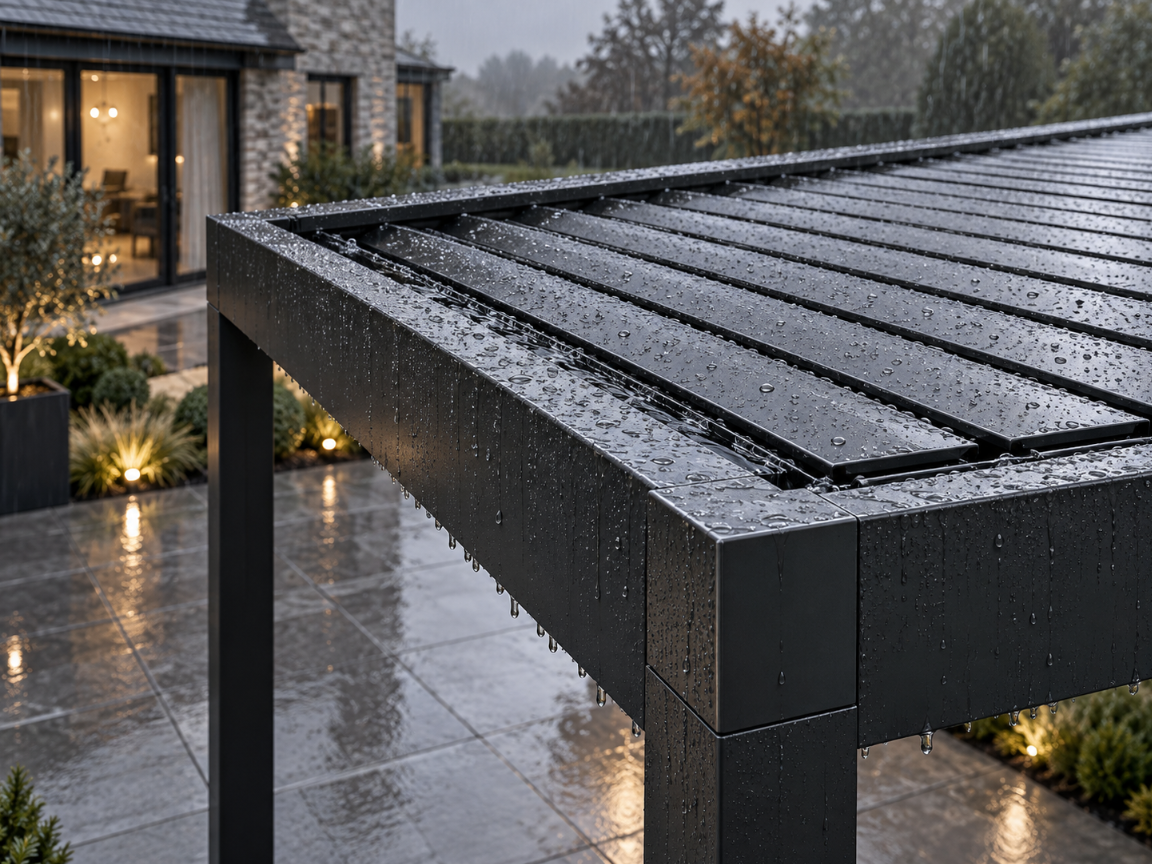
Understanding the journey of rainwater helps demystify how these structures perform in the wet. Rain lands on the closed aluminium louvres, and the angled or specially profiled blades guide the collected water towards the perimeter of the roof. From there, water flows off the ends of the blades into discreet, integrated perimeter channels built directly into the main frame beams.
Once inside the perimeter guttering, water is routed towards designated discharge points at the corners of the structure. In many modern designs, water then drops down through the hollow structural posts rather than spilling externally. Finally, it exits safely at the base of the posts, connecting to existing surface drainage or a suitable ground soakaway.
Why Can’t You See the Gutters?
Traditional garden structures and conservatories often rely on visible plastic guttering and external downpipes bolted onto the outside edges. While functional, these external additions can detract from the clean, minimalist lines of contemporary outdoor architecture.
Premium aluminium pergolas take a very different approach. By integrating the water channels directly into the perimeter roof beams and concealing downpipes inside the structural support posts, manufacturers maintain a seamless aesthetic. The guttering is doing heavy structural work while remaining completely out of sight. This architectural integration is a primary reason why high-end louvre roofs complement modern homes and contemporary landscaping so effectively.
How Do Louvre Blades Direct Water?
The secret to overhead water management lies in the geometry of the louvre blades themselves. Most premium systems use extruded aluminium blades featuring subtle internal channels or slight crowns.
When the roof is closed, each blade rests tightly against its neighbour, often aided by rubber or silicone-free sealing strips designed to prevent water from slipping between the gaps. The slight slope or contour built into the blade profile ensures that water cannot pool on top of the aluminium. Instead, gravity pulls the moisture steadily toward the outer edges of the frame, initiating the journey into the perimeter guttering.
Does Water Drain Through the Pergola Posts?
For many freestanding and wall-mounted aluminium systems, the answer is yes. The hollow interior of the structural support posts doubles as a concealed downpipe.
Water collected in the perimeter frame flows directly into the top of these posts and travels vertically down to the ground. At the base of the post, a discreet cutout or hidden outlet allows the water to escape onto the patio surface or into an underground pipe network.
This concealed post drainage creates a remarkably clean exterior appearance. There are no dangling pipes, external brackets, or awkward joints to interrupt the clean architectural lines of the structure.
Where Should Pergola Water Discharge To?
Once rainwater reaches the base of the pergola, it still needs somewhere sensible to go. Water should never simply be allowed to pool directly against the property foundations or undermine the paving slabs.
Planning the discharge point is a crucial part of the initial site survey and installation process. Depending on your garden layout, water can be directed into existing surface drainage channels, routed towards a nearby soakaway, or managed through appropriate patio grading. Professional installers will assess the surrounding levels to ensure water flows away from the living areas and patio thresholds naturally.
Wall-Mounted vs Freestanding Pergola Drainage
How a pergola is configured changes how its drainage interacts with your property. A wall-mounted system attaches directly to the exterior wall of your home.
This proximity requires careful planning. The installation must ensure that water managed by the pergola roof is not directed against exterior doors, window sills, or vulnerable masonry. Properly designed flashing and correct frame alignment ensure that the junction between the house and the pergola remains completely watertight.
Freestanding pergolas operate as independent islands within the garden. Because they do not rely on an exterior wall for support, their drainage is entirely self-contained. Water is collected by the perimeter frame and routed down the support posts on opposite sides of the structure, keeping the surrounding patio dry and protected.
What Happens in Heavy Rain?
Every drainage system has practical limits, and no outdoor shading structure should be expected to defy the laws of physics. During exceptionally intense or prolonged downpours, the sheer volume of water arriving simultaneously can test the capacity of the internal channels.
Particularly extreme rainfall can occasionally result in minor splashing over the internal guttering if the volume momentarily exceeds the flow rate of the drainage exits. This is a normal physical reality of open-air architectural structures. High-end systems are engineered with generous gutter dimensions to minimise this, but understanding these natural limits ensures realistic expectations during severe British storms.
Can Rain Still Enter From the Sides?
A louvre roof pergola is exceptionally good at managing rain arriving from directly overhead, but it is not a fully sealed glass box. Wind-driven rain can easily travel horizontally into an open-sided structure.
If you want to use your outdoor space comfortably during windy or blustery wet weather, overhead water management is only half the equation. Integrating pergola side screens can significantly reduce exposure to sideways rain, creating a sheltered garden room feel while still maintaining fresh airflow when desired.
Why Does Water Sometimes Drip When You Reopen the Roof?
It is quite common for homeowners to notice a few stray droplets falling when they open the louvres after a rain shower. This does not indicate a leak or a fault in the system.
During rainfall, residual moisture clings to the overlapping surfaces of the aluminium blades. When the motor rotates the louvres to open them, those droplets are disturbed and release downward. Most premium blade profiles are engineered to encourage residual water to roll back toward the gutter before opening, but a small amount of surface moisture is inevitable.
What About Condensation?
Water appearing underneath a pergola does not automatically mean rain is getting through the roof. Aluminium is a thermally conductive material, which means it can experience condensation when environmental conditions create sharp temperature differences between the cold outside air and the warmer microclimate underneath.
On damp mornings, moisture can form on the underside of the aluminium louvres and drip down. This is simply atmospheric condensation rather than rain penetration, and it is a common characteristic of metal architectural structures.
Do Pergola Gutters Need Cleaning?
Yes. Just like the gutters on your house, the integrated channels and drainage points of a louvre roof pergola require occasional inspection and cleaning.
Depending on where your pergola is positioned, leaves, moss, pollen, and small twigs can find their way into the roof structure over time. If left unattended, this debris can accumulate and restrict the free flow of water toward the drainage exits.
Cleaning requirements depend entirely on your local environment. Gardens surrounded by mature deciduous trees will require more frequent checks during autumn than an open patio in an urban setting.
What Happens If the Drainage Becomes Blocked?
If organic debris is allowed to build up unchecked inside the perimeter channels, the water will eventually struggle to escape. Restricted drainage can lead to slower water removal, pooling within the frame, and potential overflow over the sides of the guttering.
Routine maintenance prevents this entirely. Clearing surface debris from the louvres and periodically flushing the internal channels ensures that the rainwater management system continues to perform reliably year-round.
Why Installation Quality Matters
Even the most advanced aluminium louvre roof depends entirely on correct installation. Precision is vital when dealing with water management.
If a pergola is installed slightly out of alignment, gravity will not direct water toward the intended drainage points correctly. Professional installation ensures that the frame is perfectly squared, levels are precisely adjusted, and downpipes are correctly sealed and connected to your garden’s drainage infrastructure from day one.
Good Pergola Design Includes the Rainwater You Don’t See
A truly premium pergola should look visually effortless. The engineering that keeps you dry during a sudden summer shower should happen silently and invisibly within the aluminium frame.
When you choose a high-end louvre roof, water management is considered right alongside structural integrity, shading performance, and architectural integration. When the guttering works correctly, you will rarely have to think about it at all, allowing you to simply enjoy your outdoor space regardless of the forecast.
Speak to Shade Space About Your Louvre Roof Pergola
With over 35 years of bespoke shading expertise, Shade Space helps homeowners design tailored outdoor living environments that balance striking architecture with practical weather resilience. Whether you are exploring complex property integration, precise drainage requirements, or selecting the ideal louvre roof system for your garden, our team is here to help.
Get in touch with Shade Space today to arrange a consultation or expert site survey.