

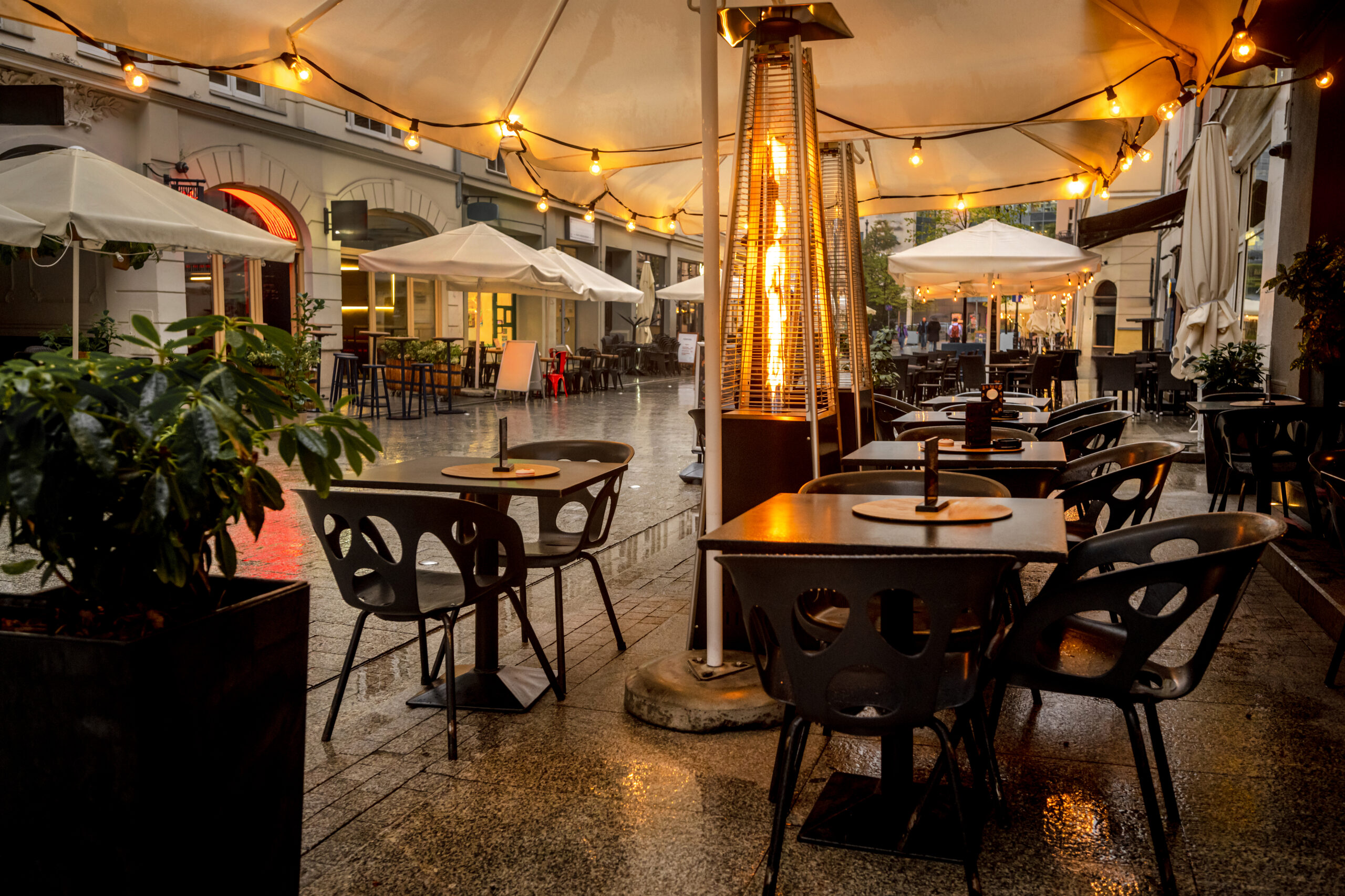
Best Parasols and Umbrellas for Outdoor Spaces in the UK
From compact garden parasols to giant commercial umbrellas, everything you need to choose the right shade solution for your home, pub, restaurant or commercial outdoor space.
1. Why parasols matter more than ever in the UK
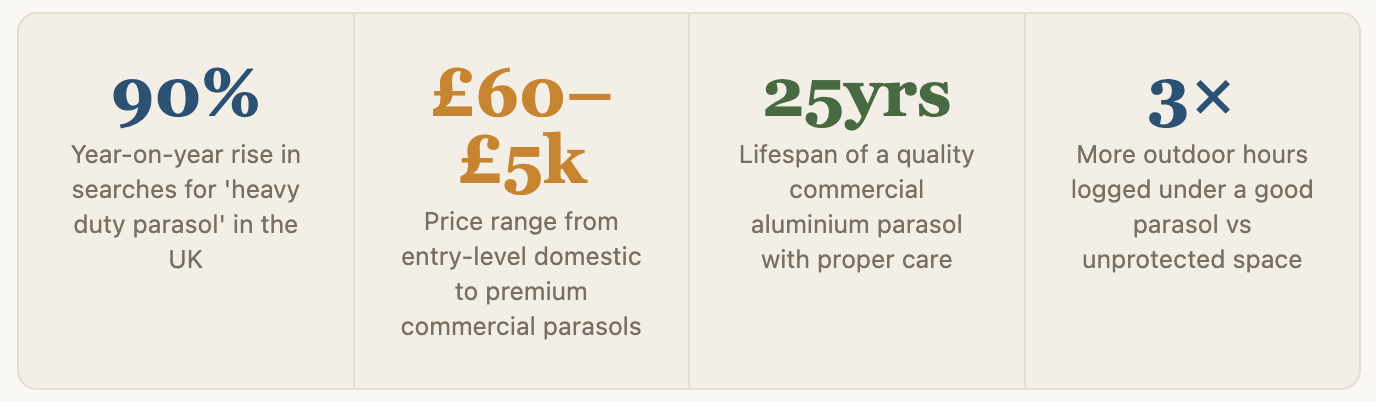
Britain’s relationship with outdoor living has changed dramatically over the past decade. Alfresco dining, garden entertaining and outdoor pub culture have become mainstream expectations — not summer luxuries. Yet our climate remains stubbornly unpredictable, with the Met Office reporting an average of 153 days of rainfall annually spread across all twelve months.
The result is growing demand for quality shade and weather protection and a market that has responded with a far wider, more sophisticated range of parasols and umbrellas than most buyers realise. Whether you’re furnishing a private patio, a boutique hotel terrace, or a 200-cover pub beer garden, the choice you make will directly affect how much time you and your guests actually spend outdoors.
“Choosing the wrong parasol doesn’t just cost you money, it costs you the outdoor season. A domestic parasol on a commercial terrace, or a tiny market umbrella over a large garden set, are both expensive mistakes.”
This guide covers every category residential to commercial, budget to premium so you can make a confident, informed decision for your specific space. If you’re already considering whether a parasol is the right solution or whether a more permanent structure like a pergola or awning would serve you better, see our companion guide: Pergola vs Awning — Which Is More Profitable for Restaurants?
2. The 5 main types of parasol and umbrella explained
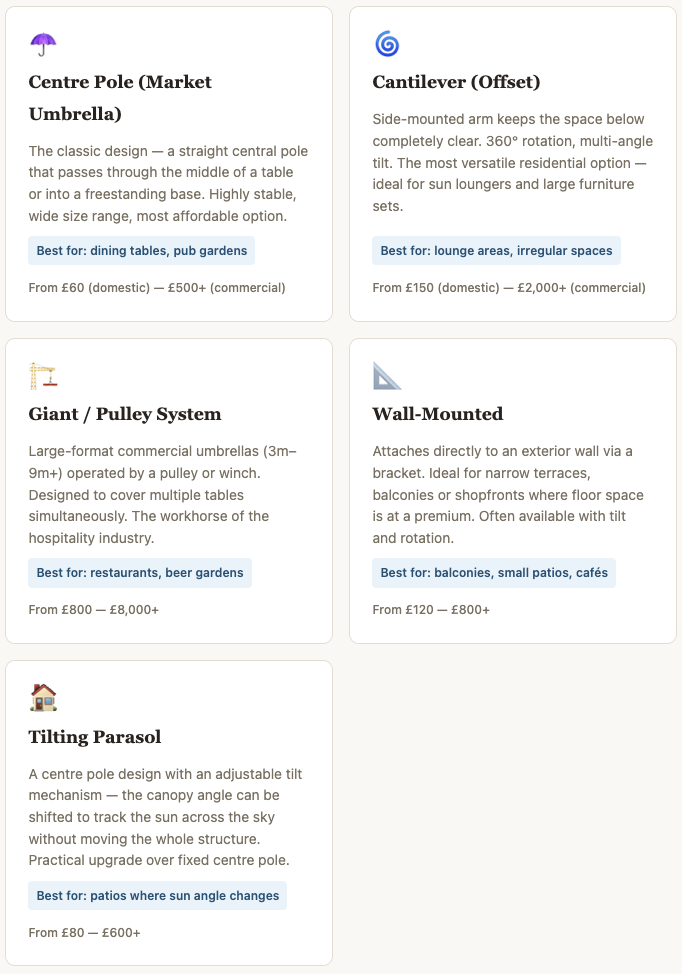
The UK market now offers five distinct parasol categories, each designed for different use cases, space sizes and budgets. Understanding these differences is the essential first step before comparing any products.
3. Side-by-side comparison
Use this table to quickly map your requirements to the right parasol type before diving into specific products.
| Type | Rain protection | Wind resistance | Flexibility | Best setting | Relative cost |
|---|---|---|---|---|---|
| Centre pole | Good (overhead) | Excellent (if anchored) | Limited tilt only | Dining tables | £ Lowest |
| Cantilever | Good (overhead) | Moderate | 360° rotate + tilt | Lounge, loungers | ££ Mid-high |
| Giant / pulley | Excellent | Excellent (in-ground) | Fixed or rotating | Commercial hospitality | £££ High |
| Wall-mounted | Good (overhead) | Moderate | Tilt + swing | Balconies, shopfronts | ££ Mid |
| Tilting | Good (overhead) | Good (if anchored) | Sun-tracking tilt | Patios, gardens | £–££ |
4. Frame materials: aluminium, wood or steel?
The frame is the skeleton of your parasol and the material choice affects durability, maintenance, weight, aesthetics and cost in ways that matter significantly in the UK’s damp climate.
Aluminium
The most popular choice for both residential and commercial settings. Powder-coated aluminium is lightweight, corrosion-resistant and requires virtually no maintenance beyond occasional cleaning. It won’t warp, split or rust. Most commercial parasols from reputable UK suppliers use marine-grade anodised aluminium, a step up from standard powder-coat, with significantly better resistance to salt air and moisture. For any commercial installation or exposed garden, given the UK’s coastal and damp climate, aluminium is the recommended default.
Timber (Teak or Hardwood)
Timber parasols particularly FSC-certified teak, offer a premium, natural aesthetic that suits traditional pub gardens and classic garden schemes. Teak is naturally oily, making it highly weather-resistant compared to softwoods. However, timber requires annual oiling or treatment to prevent cracking and greying and is heavier than aluminium, making large parasols difficult to handle. Timber is a considered choice for quality residential settings; less practical for high-volume commercial use where staff need to operate parasols quickly and repeatedly.
Steel
Steel is the strongest frame material available and is typically found in very large commercial parasols where structural integrity under wind load is the primary concern. It’s heavier, which improves stability, but requires quality powder-coating or galvanising to resist corrosion, a weak coating will rust quickly in the UK’s humid conditions. Best specified for fixed, in-ground commercial installations where the weight is not a handling consideration.
Frame material quick guide
- Domestic garden: Aluminium (lightweight, no maintenance) or timber (premium look, annual treatment required)
- Coastal or exposed location: Marine-grade anodised aluminium — standard powder-coat will corrode faster in salt air
- Commercial hospitality: Marine-grade aluminium or galvanised steel for large fixed structures
- Heritage or traditional aesthetic: FSC-certified teak — budget for annual care
5. Canopy fabric: what to look for
The canopy is your parasol’s primary functional element, it’s what stands between your guests and the sun, rain and UV radiation. Fabric quality varies enormously and the wrong choice will fade, sag or degrade within a single season of UK outdoor exposure.
Solution-dyed acrylic (e.g. Sunbrella, Dickson)
The gold standard for outdoor fabric. In solution-dyed fabrics, colour is added during fibre production — not printed on top — meaning it cannot fade out because there’s no surface dye to strip away. Solution-dyed acrylic repels moisture naturally and typically carries a 5–10 year non-fade warranty from quality manufacturers. It’s the correct specification for any commercial parasol or residential installation expected to last more than two seasons.
Polyester
The most common domestic parasol fabric and the source of the most disappointment. Polyester parasols are cheaper to manufacture but fade significantly with UV exposure, often looking washed-out within 12–18 months of outdoor use. If you’re buying polyester, look for a minimum 180g/m² weight and UV-resistant coating. Expect to replace the canopy or the whole parasol more frequently.
Olefin (Polypropylene)
A mid-ground option increasingly used in commercial parasols. Inherently UV and moisture resistant, Olefin is machine-washable and dries quickly. Not as premium as solution-dyed acrylic but significantly more durable than standard polyester. Often used by quality commercial suppliers as a cost-effective alternative to acrylic for canopies at the lower end of the commercial range.
Fabric specification checklist
- UPF 50+ rating — blocks 98%+ of UV rays, protects guests and furniture underneath
- Water-repellent finish — not the same as waterproof; most parasols shed light rain but are not designed for torrential downpours
- Double vent at crown — allows wind to pass through rather than lift the canopy; the single most important wind-resistance feature
- Solution-dyed acrylic for any installation expected to last 5+ years
- Check fabric weight — for commercial use, 250g/m²+ is advisable
6. Choosing the right size
Sizing is where many buyers go wrong, either underestimating how much coverage they need, or over-specifying a canopy that overwhelms the space. The rule of thumb is simple: your parasol canopy should extend at least 0.5m beyond your furniture on each side to provide genuine shade at typical sun angles.
| Use case | Recommended canopy size | Notes |
|---|---|---|
| 2-person café table | 2m–2.5m round | Standard bistro configuration |
| 4-person garden dining | 2.7m–3m round or square | Most popular domestic size |
| 6-person outdoor dining | 3m–3.5m | Consider rectangular for oblong tables |
| Sun lounger pair | 3m+ cantilever | Side-mounted arm keeps space clear |
| 2–4 pub/restaurant tables | 4m–6m giant | In-ground base essential |
| Large commercial terrace | 6m–9m+ or multiple parasols | Coupled systems can cover 78m²+ |
For cantilevered parasols, note that a 4m cantilever canopy requires a base weight of at least 100kg to remain safe in moderate UK winds. Always factor base weight into your size decision, the larger the canopy, the more critical the anchoring.
7. Best parasols for commercial use (pubs, restaurants, cafés)
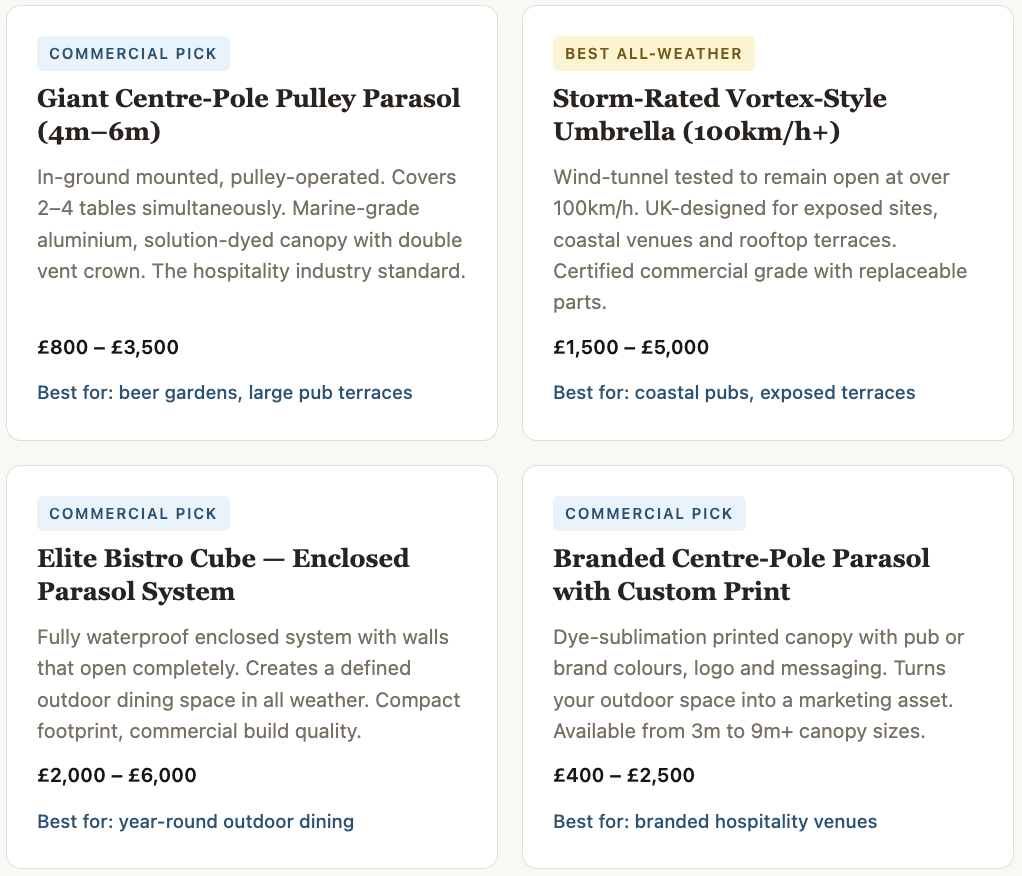
Commercial parasols are a fundamentally different product category from domestic garden parasols — built to heavier specifications, higher wind ratings and greater durability to withstand daily operation, staff handling and the full British weather spectrum. Domestic parasols used in commercial settings will fail quickly, potentially dangerously, and the savings on purchase price will be rapidly consumed by replacement costs and liability exposure.
If you’re extending your pub or bar’s outdoor trading season, parasols are a faster and lower-cost route to weather protection than a full pergola installation — though they offer less comprehensive cover. For a full comparison, see our guide: How to Extend Your Pub or Bar’s Outdoor Season by 3 Months.
Commercial parasol non-negotiable
- Specify marine-grade anodised aluminium or galvanised steel — standard powder-coat degrades faster under daily use
- In-ground bases for permanent installations — removes trip hazards and dramatically improves wind stability
- Wind rating must be specified and documented — your liability insurer will want to see this
- Choose motorised or pulley operation — staff in a busy service shouldn’t be wrestling a manual crank
- Ensure replacement parts and canopies are available — you don’t want a blown canopy in August to mean replacing the entire system
- Check planning position — branded parasols visible from the street may require advertisement consent
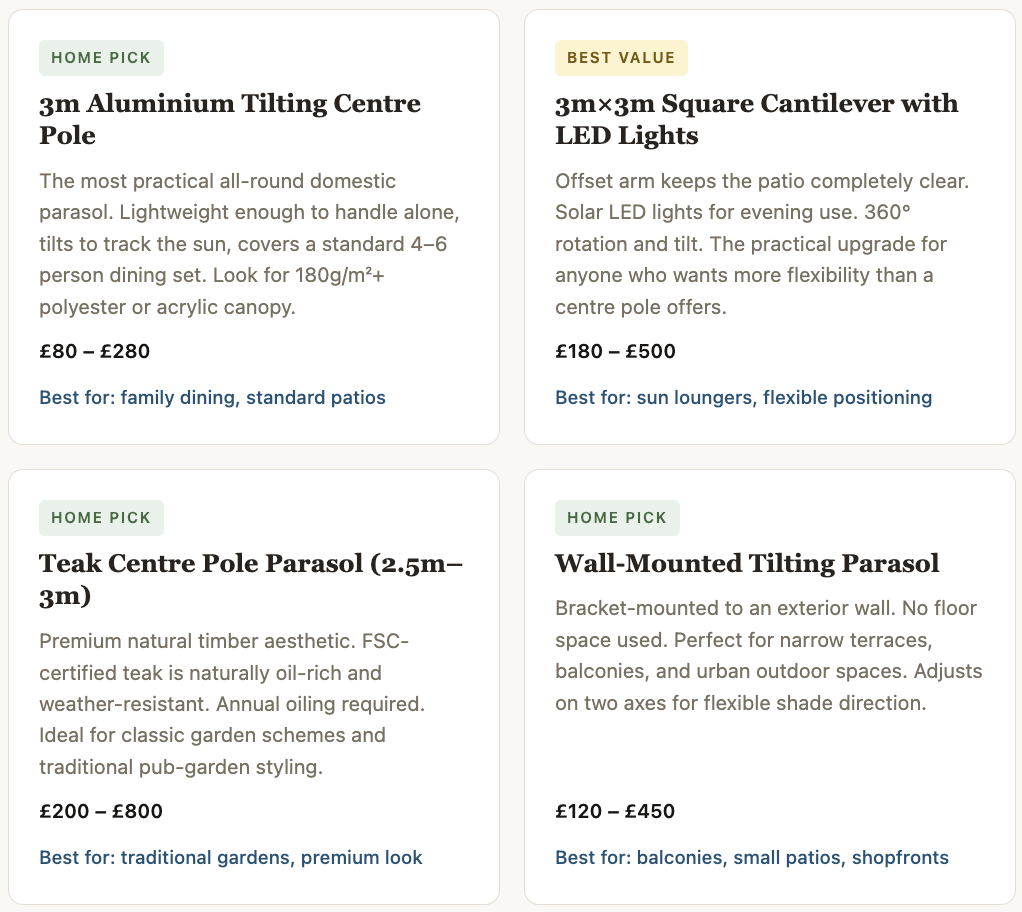
8. Best parasols for home gardens and patios
For residential buyers, the priorities shift from commercial durability toward value, aesthetics and ease of use. A good domestic parasol should last 5–10 years with reasonable care, look attractive in your garden scheme, and be manageable by one adult to open, close and store.
9. Bases and stability: the most overlooked decision
The parasol base is the most safety-critical component of any installation and the most commonly underspecified. A parasol that blows over in wind is not just a nuisance: it’s a liability. The Health & Safety Executive’s guidance on outdoor structures is clear that operators must ensure structures cannot cause harm to employees or the public.
Centre pole parasols
When a centre pole parasol passes through the hole of a dining table, the table itself contributes significant lateral stability meaning the base requirement is lower than for freestanding installations. For truly freestanding use, look for bases weighing a minimum of 15–25kg for a 2.5m parasol, scaling significantly for larger canopies.
Cantilever parasols
Cantilevers require disproportionately heavy bases because the canopy is offset creating a large leverage force on the base. A 4m square cantilever ideally requires a 240kg base for safe operation. Many cheap cantilever sets come with inadequate bases always verify the filled weight (sand or water) rather than empty shipping weight.
Commercial installations
For any commercial hospitality setting, an in-ground base a steel socket set in concrete at least 60cm deep is the recommended standard. It’s the most secure option, sits flush with decking or paving to eliminate trip hazards, and dramatically reduces wind vulnerability. Mobile or wheeled bases are a compromise that should be reserved for situations where the parasol genuinely needs to move daily.
Base types at a glance
- In-ground socket (commercial): Most secure. Set in concrete. Eliminates trip hazard. Best for fixed commercial use.
- Concrete ring base: Heavy, splits for handling. Good for larger bistro parasols in semi-permanent positions.
- Granite / cast-iron base: Premium aesthetic, weighty, often used residentially. Verify total weight for your canopy size.
- Sand/water-fill plastic base: Budget option. Check filled weight — many are dangerously underspecified.
- Cross-base with ballast: Common with cantilevers. Stable on four points. Ensure all four feet are weighted.
10. Accessories that genuinely extend usability
A quality parasol on its own extends your usable outdoor time considerably. The right accessories push that further — turning a shade structure into a genuinely comfortable outdoor environment from March through November.
Infrared heating
Mounted to the parasol pole or a nearby wall bracket, infrared heaters warm guests directly rather than the ambient air making them dramatically more effective outdoors than gas mushroom heaters. A 3kW remote-controlled infrared heater is the most practical specification for a commercial parasol; for domestic use, a 1.5–2kW unit suits most situations. Combined with parasol shade, heating allows genuine outdoor use on cool spring and autumn evenings. Read more about outdoor heating options in our guide: How to Extend Your Outdoor Season.
LED parasol lighting
Integrated LED strip lights running along the ribs or around the valance create evening ambience and extend outdoor dwell time significantly. Solar-powered LED options are available for domestic use; hardwired LED systems are recommended for commercial installations requiring reliable, consistent output. Waterproof rating (IP65 minimum) is essential for any outdoor electrical fitting.
Side screens and windbreaks
Overhead parasols address sun and vertical rain but not lateral wind or driving rain. Pairing a parasol with retractable side screens or windbreak panels significantly improves usability in the UK’s frequently gusty conditions. For commercial installations, see our full range of commercial external blinds and screens designed to work alongside outdoor shade structures.
Protective covers and bags
UV-resistant parasol covers are the simplest way to significantly extend fabric life protecting from UV degradation and soiling when the parasol is not in use. Essential for any domestic installation; for commercial installations where parasols are in daily use, specify a quality cover for overnight and off-season storage.
11. Maintenance and longevity
A quality parasol, properly maintained, should last a decade or more in residential use and up to 25 years in a commercial aluminium installation. The maintenance regime is straightforward but must be consistent.
- Regular cleaning: Wash the canopy with mild soapy water and a soft brush every 4–6 weeks during the season. Remove bird droppings and debris promptly — they accelerate fabric degradation and can cause mould
- Mechanism care: Lubricate crank and pulley mechanisms annually with a light silicone spray — do not use WD-40 on nylon components
- Storm protocol: Close the parasol in any sustained wind over Beaufort Force 3 (roughly 20km/h). Even wind-rated parasols benefit from being closed in conditions they aren’t designed to resist continuously
- Winter storage: For domestic parasols, store indoors or in a garage through winter months. For commercial fixed installations, close and cover the canopy. Timber poles should be treated before winter storage
- Canopy replacement: Most quality commercial parasols have replaceable canopies — this is significantly cheaper than replacing the whole structure and should be factored into your long-term cost model
Not sure whether a parasol or a more permanent shade structure is the right choice for your space? Contact the Shade-Space team for a free consultation, we can assess your site, your usage needs and your budget to recommend the most cost-effective solution