

How to Extend Your Pub or Bar’s Outdoor Season by 3 Months
The beer garden is one of the most powerful revenue assets a pub can have — on a warm May afternoon, it can double your capacity and draw in passing trade that your indoor space never would. But for most UK operators, that same space sits dark and empty from October through March, and becomes unreliable the moment clouds appear between April and September.
That’s a significant chunk of the year haemorrhaging potential revenue. DesignMyNight’s 2025 Pub Industry Report highlights that the difference between thriving and struggling operators increasingly comes down to how creatively they use every square metre of their venue. Outdoor space, properly sheltered, is one of the most cost-effective ways to grow capacity without the planning headache or capital outlay of a full building extension.
In this guide, we’ll walk through every practical solution available to UK pub and bar operators, from louvred pergolas to infrared heating and show you how combining them intelligently can add as many as three fully tradeable months to your outdoor calendar.
1. The great British outdoor problem
Let’s start with the numbers. Met Office climate data shows the UK averages around 153 days of rainfall per year, with rain spread across all twelve months. Wind speeds regularly exceed the threshold at which standard awnings must be retracted. And temperatures drop below comfortable outdoor drinking conditions — broadly below 12°C — for around five months of the year.
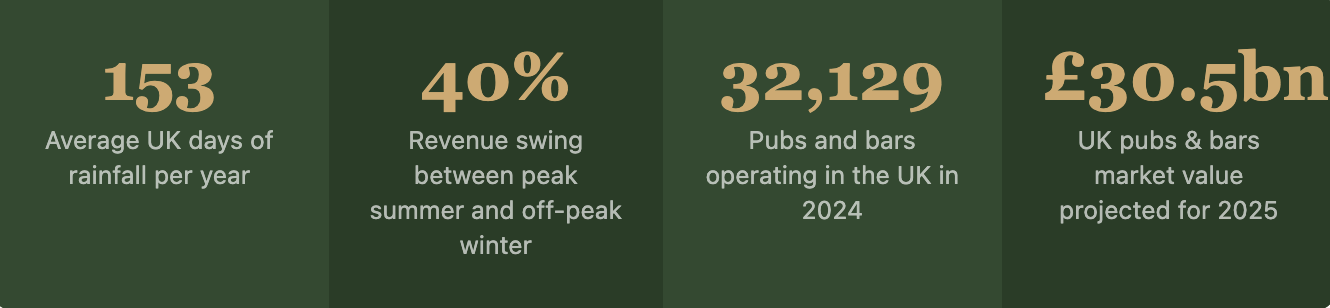
The result? For the average unprotected pub garden, the genuinely reliable outdoor trading window is roughly May to September five months, best case. With marginal weather in April and October bringing further uncertainty, many operators effectively write off their outdoor spaces for seven months of the year.
“The difference between a beer garden and a revenue engine is simple: weather protection. One gives you five months of trading. The other gives you twelve.”
And the stakes are rising. Mintel’s 2025 UK Pubs & Bars report notes that 63% of pub customers report reducing visit frequency due to cost-of-living pressures meaning operators need to extract more value from every customer who does come through the door. An all-weather outdoor space that keeps guests comfortable, drinking and returning is no longer a luxury consideration: it’s a commercial necessity.
2. Understanding your outdoor revenue calendar
Here’s what a typical UK pub’s outdoor season looks like and what’s possible with the right weather protection in place.

With a fully equipped sheltered outdoor space, louvred pergola, infrared heating, side screens — the picture changes dramatically:

3. Solution 1: The louvred roof pergola — the biggest single upgrade
If you invest in one thing to extend your outdoor season, make it a commercial louvred roof pergola. Nothing else delivers as dramatic a transformation to your outdoor space’s usability — or to the experience of the guests sitting in it.
A louvred pergola features adjustable aluminium roof blades that can rotate from fully open (allowing sun and warm air to flood in) to fully closed (creating a weatherproof seal that sheds rain through integrated guttering). High-end commercial systems from brands like Weinor and Tarasola also integrate LED lighting strips, so your outdoor space looks exceptional in the evenings — which is precisely when your most valuable covers are being turned.
What it actually solves
- Rain: Closed louvres drain water through concealed gutters — guests stay dry even in a downpour
- Glare: Partly open louvres control the angle of sunlight, eliminating the blinding conditions that drive guests indoors on bright days
- Evening ambience: Integrated LED lighting creates a genuinely attractive outdoor room after dark
- Wind: The structure itself provides significant wind reduction (enhanced further with side screens — see below)
- Brand perception: A well-designed pergola transforms a “garden” into a premium outdoor destination worth posting about
Commercial pergola specification notes
- Specify aluminium over timber for commercial settings — far lower maintenance and longer lifespan (25+ years)
- Ensure the system is rated for commercial wind loads — domestic pergolas are not built to the same standard
- Choose a motorised louvre system, not manual — staff in a busy service shouldn’t be operating a crank handle
- Integrated rain sensors that close the louvres automatically are worth the premium in a hospitality setting
- Check the drainage capacity — a large surface area in heavy rain can overwhelm an undersized gutter system
For a full breakdown of how pergolas compare to awnings on cost, ROI and weather protection in a commercial context, see our detailed guide: Pergola vs Awning for Restaurants — Which Is More Profitable?
4. Solution 2: Commercial retractable awnings — the fast, flexible fix
For pub operators who need a quicker or more budget-conscious route to weather protection, a commercial retractable awning is a compelling option — provided you understand its limitations clearly before you invest.
A commercial cassette awning mounts to an exterior wall and extends outward on a motorised arm system, deploying in seconds. A quality system from a manufacturer like Markilux can cover a significant terrace area and add meaningful shade and rain protection for a fraction of the cost of a pergola.
Awning advantages for pubs and bars
- Significantly lower upfront cost: £2,000–£8,000 for commercial-grade systems versus £12,000–£30,000+ for a pergola
- Faster installation — typically one to two days versus several days for a structural pergola
- Branded fabric options: your pub name and colours printed directly onto the canopy creates instant street presence and brand visibility
- Retractable design means no visual clutter when not in use — the facade stays clean
- Cassette design protects fabric when retracted, extending lifespan
Awning limitations to know upfront
- Most commercial awnings must retract in sustained winds above Beaufort 3–4 (12–28 km/h) — a common occurrence across the UK
- Rain protection is overhead only: wind-driven rain (which accounts for the majority of UK rainfall) will still reach guests
- No thermal benefit — guests will still feel cold in autumn and winter even when the awning is deployed
- Fabric lifespan is typically 5–8 years; planned replacement costs must factor into your total ownership model
For many operations, the optimal solution is an awning now and a pergola later using the awning’s lower cost to generate additional outdoor revenue while longer-term investment plans mature.
5. Solution 3: Infrared heating — the season extender that’s often overlooked
Temperature is the factor most operators underestimate when planning outdoor season extension. Shelter from rain and wind is essential but if guests are cold, they’ll head inside regardless of how well-covered they are. This is where infrared heating transforms the equation.
Unlike conventional patio heaters that warm the air (which immediately disperses outdoors), infrared heaters warm objects and people directly the same principle as sunlight. The result is genuine warmth for guests sitting beneath them, even when the ambient temperature is well below comfortable levels. A well-positioned infrared system allows outdoor dining in March and November in comfort that would otherwise be impossible.
| Heater type | Effectiveness outdoors | Energy efficiency | Best for |
|---|---|---|---|
| Infrared ceiling/wall-mounted | Excellent | High | Under pergola, covered areas |
| Gas patio heater (mushroom) | Moderate | Low | Open areas, quick setup |
| Electric fan heater | Poor | Moderate | Not suitable outdoors |
| Overhead gas radiant | Good | Moderate | Larger open areas |
Mounted infrared heaters integrate cleanly into pergola structures and covered areas, are operated remotely or via smart controls, and consume significantly less energy than gas alternatives. Many commercial pergola systems including those supplied by Shade-Space can be specified with integrated infrared heating as a single cohesive system, rather than retrofitting standalone heaters as an afterthought.
Heating quick wins
- Position heaters to cover seating zones, not walkways — directing heat at tables, not sky
- Zone your heating so you’re only running heaters above occupied tables — smart controls help significantly
- Communicate clearly to guests that heating is available — “heated outdoor terrace” in your marketing adds genuine footfall
- Consider heated seat cushions for additional comfort at key tables during winter events
6. Solution 4: Retractable side screens and windbreaks
Rain comes down. Wind comes sideways. Addressing only the overhead element of weather protection leaves a significant gap and in the UK, it’s often lateral wind and driving rain that empties an outdoor space fastest.
Retractable side screens — either clear PVC (maintaining views and light while blocking wind and rain), printed fabric, or glass panels complete the weatherproofing envelope when combined with an overhead solution. They can be deployed selectively depending on wind direction, and retracted fully on warm still evenings when the space benefits from complete openness.
- Clear PVC screens: Maintain views and natural light, highly effective wind and rain barrier, budget-friendly
- Glass sliding panels: Premium appearance, genuinely architectural feel, transforms the space into a semi-enclosed room best for gastropubs and destination venues
- Printed fabric blinds: Branding opportunity, strong privacy and weather protection, lower cost than glass
For pubs on exposed sites coastal locations, hilltop settings, open high streets side screens aren’t optional. They’re the difference between a sheltered space guests want to use and a wind tunnel they flee. See our full external blinds and screens range for options suited to commercial hospitality settings.
7. How to combine solutions for maximum season extension
The three-month season extension goal is most reliably achieved by combining solutions not relying on any single element. Here’s how the layers work together:
The full-season outdoor setup
- Layer 1 — Louvred pergola roof: Handles rain from above. Opens for sun, closes for rain. Integrated LED lighting extends the evening trade window.
- Layer 2 — Retractable side screens: Handles wind and driving rain from the sides. Deployed as needed depending on conditions and direction.
- Layer 3 — Infrared ceiling heaters: Handles temperature. Mounted within the pergola, they make October, November and March genuinely comfortable.
- Layer 4 — Branded details: Consistent upholstery, lighting warmth and visual identity communicate that this is a premium space worth choosing over the indoor alternative.
The result is an outdoor space that responds to British weather rather than surrendering to it. On a warm July evening, the louvres open and the screens retract guests feel like they’re outside. On a wet October lunchtime, the louvres close, screens deploy, and heaters fire up guests are warm, dry and comfortable. The space works in both scenarios.
8. Planning permission: what pub operators need to know
This is where many operators get caught out. The planning rules for commercial hospitality properties are significantly more complex than for residential settings and acting without checking first can result in costly enforcement notices.
Government rules introduced during the Covid pandemic and since made permanent allow hospitality businesses to install pergolas and certain temporary structures without full planning consent, provided the structure is under 2.5 metres in height and covers less than half the available outdoor space. However, there are critical exceptions:
- Listed buildings — always require listed building consent and full planning permission
- Conservation areas — stricter rules apply; always verify with your local planning authority
- Structures over public pavement — require highways approval and a pavement licence
- Change of use — converting outdoor space to a formal dining area with lighting, heating and enclosure may be classed as a change of use, triggering a planning application
- Branded awnings — awnings that include logos or brand graphics may require separate advertisement consent
Planning rule of thumb for pub operators
If you’re adding a freestanding louvred pergola to a private rear beer garden, under 2.5m, covering less than half the space, you’re likely fine under permitted development. The moment you’re on a public-facing frontage, in a conservation area, listed, or creating enclosed dining space speak to your local planning authority before purchasing anything. A pre-application enquiry via the Planning Portal costs little and could save thousands.
At Shade-Space, our commercial team has extensive experience supporting pub and hospitality operators through the planning process and can advise on structures most likely to achieve approval in your specific situation. Get in touch for a consultation.
9. ROI: does it actually pay off?
Let’s be direct about this, because it’s the question every pub operator rightly asks before signing off on a capital investment.
Consider a typical community pub with a 30-cover beer garden. Average spend per head of £22, two sittings on a busy evening service. Without weather protection, that garden reliably trades five months of the year say 150 days.
- Unprotected garden annual revenue: 150 days × 60 covers × £22 = £198,000
- Protected garden (9 months, 270 days): 270 days × 60 covers × £22 = £356,400
- Annual revenue uplift: £158,400
Even accounting for the fact that winter days will never fully replicate peak summer performance, a conservative 50% occupancy assumption on the extended months still delivers over £79,000 in additional annual outdoor revenue. Against a louvred pergola investment of £15,000–£25,000, the payback period is well under two years often less than twelve months for a busy operation.
And this analysis doesn’t capture the indirect benefits: the marketing pull of a beautiful covered terrace, the social media content it generates, the event bookings it enables (Christmas parties, private dining, quiz nights with outdoor overflow), or the competitive differentiation it creates in your local market.
10. Your outdoor season extension checklist
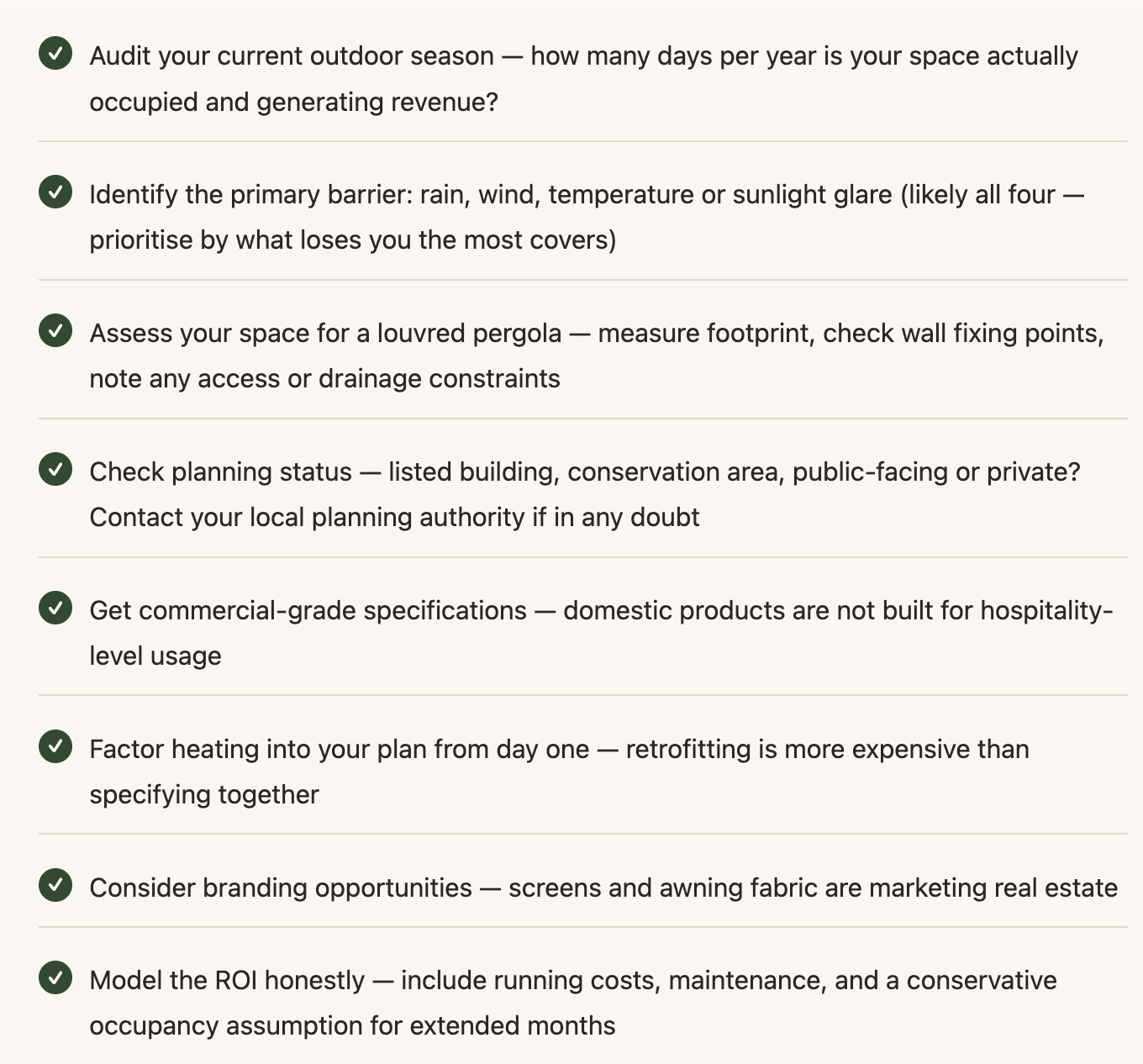
Talk to a specialist installer with commercial hospitality experience, Shade-Space offers free consultations and site visits
You may also find our related guide useful: Awnings vs Pergolas — Which Outdoor Solution Is Right for You? which covers the residential perspective on the same core question.