


Pergola vs Awning for Restaurants: Which Is More Profitable?
Your restaurant’s outdoor space is one of the most powerful revenue levers you have but only if guests actually want to sit in it. Whether it’s the blazing summer sun or an unexpected British drizzle, an uncovered terrace loses covers the moment conditions shift.
The two dominant solutions for hospitality operators are pergolas and awnings. Both extend the usability of your alfresco space, but they differ enormously in cost structure, customer appeal, planning requirements and long-term return. This guide breaks down every factor that matters to a restaurant owner’s bottom line, so you can invest with confidence.
1. Why outdoor shade structures matter for profitability
The commercial case is clear. According to research by UK Hospitality, outdoor seating can account for 20–40% of a restaurant’s total covers during peak season. That’s a substantial portion of revenue that evaporates the moment guests feel uncomfortable.
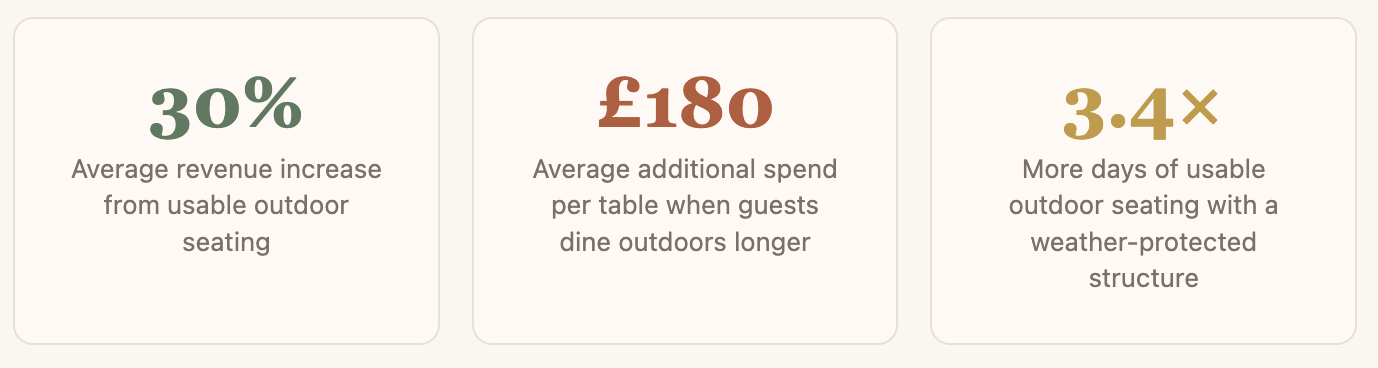
Beyond raw covers, research on hospitality dwell times consistently shows that guests seated in comfortable, aesthetically pleasing outdoor spaces stay longer and spend more. Shade and weather protection are the foundation of that comfort.
In hospitality, cover count is vanity – usable cover count is profit. A terrace only earns its square footage when guests actually choose to sit there.
2. Pergola vs awning at a glance
Before diving into the financial detail, here’s a quick orientation on what each structure actually is.
A pergola is a freestanding or wall-mounted structure with a solid or louvred roof, typically built from aluminium, timber, or steel. Modern commercial pergolas such as louvred roof systems feature adjustable roof panels that can open fully for sun or close tight against rain, with optional integrated lighting, heating, and screens.
An awning is a retractable or fixed fabric canopy mounted to an exterior wall. Operated manually or motorised, awnings extend outward to provide shade, then retract when not needed.
| Factor | Pergola Premium | Awning Entry-level |
|---|---|---|
| Structure type | Freestanding or wall-mounted, solid/louvred roof | Wall-mounted fabric canopy |
| Typical cost (commercial) | £8,000 – £35,000+ | £800 – £6,000 |
| Rain protection | Full (closed louvres or solid roof) | Partial – wind-driven rain penetrates |
| Usable season (UK) | 10–12 months | 4–7 months |
| Planning permission | Often required for commercial sites | Usually permitted development |
| Atmosphere / branding | High – architectural, premium feel | Moderate – functional, branded fabric |
| Lifespan | 20–30+ years | 5–12 years |
| Maintenance | Low (aluminium systems) | Moderate (fabric cleaning/replacement) |
| Add-on options | Heating, lighting, screens, speakers | Valance branding, basic LED strips |
3. Cost comparison: upfront vs long-term
The most common mistake operators make is comparing sticker prices without accounting for total cost of ownership. An awning looks dramatically cheaper on day one — but the 10-year picture is often much closer.
Awning costs
A commercial-grade motorised cassette awning from a reputable supplier typically costs £1,500–£6,000 for a medium terrace, including installation. However:
- Fabric replacement is typically needed every 5–8 years: £400–£1,200 per replacement
- Motor servicing and mechanism repairs add £100–£400 per incident
- Winter storage or additional weatherproofing products may be required
- Awnings typically carry shorter warranties than aluminium pergola systems
Pergola costs
A commercial aluminium louvred pergola covering a medium terrace (30–60m²) typically runs £12,000–£28,000 installed. Premium systems with integrated heating, lighting and screens can exceed £40,000 for larger footprints. That said:
- Quality aluminium systems require virtually no maintenance beyond annual cleaning
- Lifespans of 25–30 years are typical for powder-coated aluminium structures
- The asset adds tangible value to the property or business
- Many operators achieve full ROI within 3–5 years through increased covers and extended season
10-Year Cost Modelling Example
A 40m² terrace, mid-range scenario:
- Awning: £4,000 install + £1,500 fabric replacement (yr 6) + £600 servicing = ~£6,100 over 10 years. Limited to ~5 usable months/year.
- Pergola: £18,000 install + £300 cleaning/maintenance = ~£18,300 over 10 years. Usable 10–11 months/year — potentially 2× the annual revenue opportunity.
When modelled against realistic cover revenue, the pergola typically pays for itself in full within 4 years for a busy restaurant.
4. Revenue impact and ROI
This is where the pergola’s premium becomes most defensible. The core equation is simple: more usable days × more covers per day × average spend per cover = total outdoor revenue.
According to The Access Group’s hospitality research, the average UK restaurant sees outdoor seating generating meaningful revenue for roughly 120–150 days per year without any weather protection. A louvred pergola with heating and side screens can extend that to 280–320 days — more than doubling the commercial window.
Consider a 20-cover outdoor terrace with an average spend of £35/head and two sittings per service:
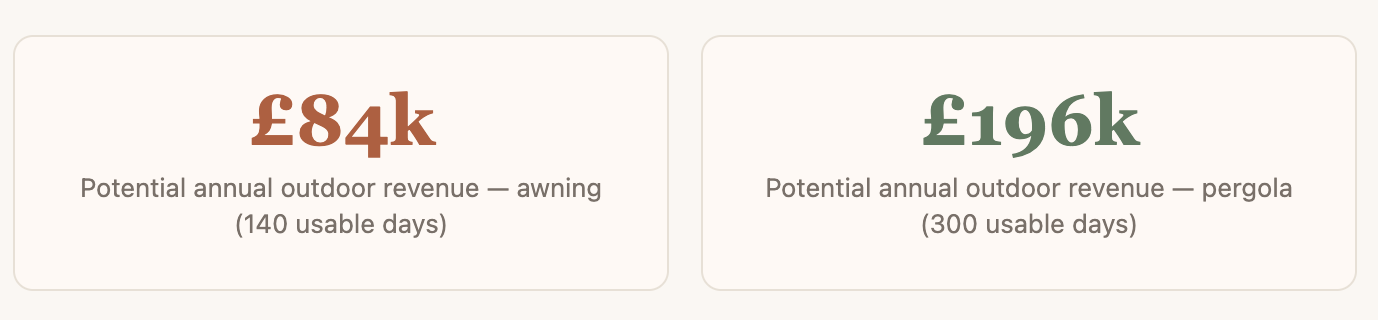
The £112,000 annual revenue differential dwarfs even a premium pergola investment — and that’s before accounting for the premium positioning that a beautifully designed covered terrace creates. ONS data on weather and consumer behaviour confirms that outdoor environments perceived as comfortable and sheltered command higher average spend.
Awning ROI considerations
Awnings make strongest financial sense when:
- Budget is constrained and the priority is shade rather than rain protection
- The terrace is already partially sheltered by a building overhang
- You’re in a mild microclimate (sheltered courtyard, south-facing terrace)
- The outdoor space is secondary to your indoor operation
5. Customer experience and atmosphere
Profitability isn’t purely a function of covers × spend. Reputation and repeat visits are driven by experience — and outdoor dining experience is increasingly a differentiator in a competitive hospitality market.
A well-designed pergola creates a genuinely architectural outdoor room. With integrated LED lighting, infrared heating panels, retractable side screens and a louvred roof that can filter dappled light or close against a downpour, the effect is transformative. Guests feel they’re in a premium, considered space — not just sitting under a shop canopy.
Research by TripAdvisor’s restaurant research team consistently finds that ambience is one of the top three drivers of positive reviews, alongside food and service. An outdoor space that genuinely impresses guests generates social media content, word-of-mouth, and repeat bookings — all of which compound over time.
Pergola atmosphere advantages
- Architectural presence that photographs well and drives social sharing
- Can be branded and customised (RAL colour choices, custom screens)
- Integrated heating allows all-weather dining without the awkwardness of patio heaters
- Creates a genuinely distinct dining space — not just an extension of the pavement
- Acoustic improvement over open terrace reduces noise complaints
Awning atmosphere advantages
- Fabric can be printed with brand colours, logo or patterns
- Lighter, more open feel on warm sunny days
- Doesn’t dominate the building’s facade aesthetically
- Suitable for heritage buildings where a structural pergola might be intrusive
6. Planning permission and regulations (UK)
This is a critical practical consideration that catches many operators off guard.
Awnings: are generally considered permitted development for most commercial premises under the Town and Country Planning (General Permitted Development) Order, provided they don’t materially alter the building’s character. Listed buildings and conservation areas are important exceptions always verify with your local authority.
Pergolas: particularly freestanding structures are more likely to require formal planning consent. Key triggers include:
- The structure exceeds 2.5m in height
- The footprint covers more than 50% of the curtilage
- The site is within a conservation area, AONB, or World Heritage Site
- The building is listed (any grade)
The Planning Portal’s interactive guide is an excellent starting point, but for commercial hospitality sites, we strongly recommend consulting your local planning authority or a specialist planning consultant before purchasing any structure.
The good news: planning applications for well-designed pergolas on commercial hospitality sites are routinely approved, particularly when the structure demonstrates quality and respect for the surrounding environment. The process typically takes 8-12 weeks and costs £200-£500 in application fees for most English authorities.
7. Weather protection and seasonality
For UK hospitality operators, this may be the single most decisive factor. Britain’s weather is the enemy of outdoor dining revenue and the two structures address it very differently.
Awning limitations
A retractable awning excels at solar shading on bright days. It’s a genuine improvement over an unprotected terrace. However:
- Wind limits retraction — most manufacturers specify maximum wind speeds of Beaufort 3–4 (12–28 km/h), which is exceeded regularly across the UK
- Rain blows in — fabric awnings provide overhead cover but offer no lateral protection, making them ineffective during the sideways drizzle that characterises much of the UK’s rainfall
- Temperature — an awning provides no thermal benefit; guests still feel cold air and wind chill
- Winter use — most fabric awnings should be retracted and ideally stored through winter, removing all outdoor revenue from approximately November through February
Pergola advantages in UK climate
A louvred pergola with optional side screens and infrared heating is specifically engineered for the UK’s unpredictable climate. When the louvres close, rain drains through integrated guttering. Side screens block wind. Infrared heaters warm guests without heating the open air. The result is a genuinely usable outdoor space in conditions that would empty an unprotected terrace — light rain, overcast days, early spring and late autumn evenings.
For Met Office climate data, the UK averages 153 days of rainfall per year — meaning without rain protection, you’re limiting your outdoor season significantly. A pergola effectively neutralises most of those lost days.
8. Maintenance requirements
Maintenance is a hidden cost that’s easy to underestimate. In a busy restaurant, the last thing your team needs is a complex or time-consuming maintenance regime for an outdoor structure.
Awning maintenance
- Fabric cleaning: every 1–3 months with a soft brush and mild detergent — bird droppings and algae can degrade waterproofing
- Mechanism lubrication: annually for motorised systems
- Fabric replacement: typically required every 5–8 years; sun degradation and tear accumulation are the primary causes
- Winter retraction: fabric should be retracted and inspected before winter weather; some operators invest in additional protective covers
Pergola maintenance
Quality powder-coated aluminium pergolas from reputable suppliers are genuinely low-maintenance. Annual tasks include:
- Cleaning frames and roof panels with a hose and mild detergent
- Inspecting gutter channels and drainage points
- Checking fixings and connections (especially after severe weather)
- Servicing motorised louvre mechanisms every 2–3 years
Unlike timber pergolas — which require staining, sealing, and eventual replacement — a well-specified aluminium system should look and function like new for two decades with minimal effort. This matters in an operational context: your front-of-house staff should be serving guests, not maintaining outdoor structures.
The verdict: which is more profitable?
For most serious restaurant operators with a meaningful outdoor space, a pergola delivers superior long-term profitability — but the right answer depends on your specific situation.
You have a significant outdoor space, want to maximise usable days, plan to operate for 5+ years, and can absorb a higher upfront investment for a premium return. Ideal for destination restaurants, gastropubs, and hotel terraces.
Budget is constrained, the outdoor space is supplementary, your climate is mild, or you need a rapid low-commitment solution — perhaps while planning a more permanent structure. Excellent for café frontages and sheltered courtyards.