

Full Cassette vs Half Cassette Awnings: Which is Right for Your Home?
Choosing a retractable awning involves more than deciding on its size, fabric colour and whether it should be motorised.
One of the most important decisions is how the awning is housed when it is not in use.
This is where terms such as full cassette, half cassette and mini cassette awnings start to appear.
At first glance, the difference may seem relatively small. All of these systems extend outwards to create shade and retract neatly against the property when they are no longer required.
However, the type of cassette affects how much of the fabric and mechanism is protected when the awning is closed, how discreet the system looks against the building and which installation may be best suited to your property.
In this guide, we explain the differences between full cassette and half cassette awnings so you can make a more informed choice for your patio, terrace or garden.
What is a Cassette Awning?
The cassette is the housing that sits against the exterior of the property and contains the awning when it retracts.
Think of it as the awning’s protective shell.
When a retractable awning closes, the fabric rolls back towards the building while the folding arms return towards the cassette.
How completely these components are enclosed depends on the type of cassette chosen.
There are several designs available, but most residential folding arm awnings fall into three broad categories:
- Full cassette awnings
- Half or semi-cassette awnings
- Open awning systems
For homeowners investing in a premium installation, full and half cassette systems are often the main options considered.
What is a Full Cassette Awning?
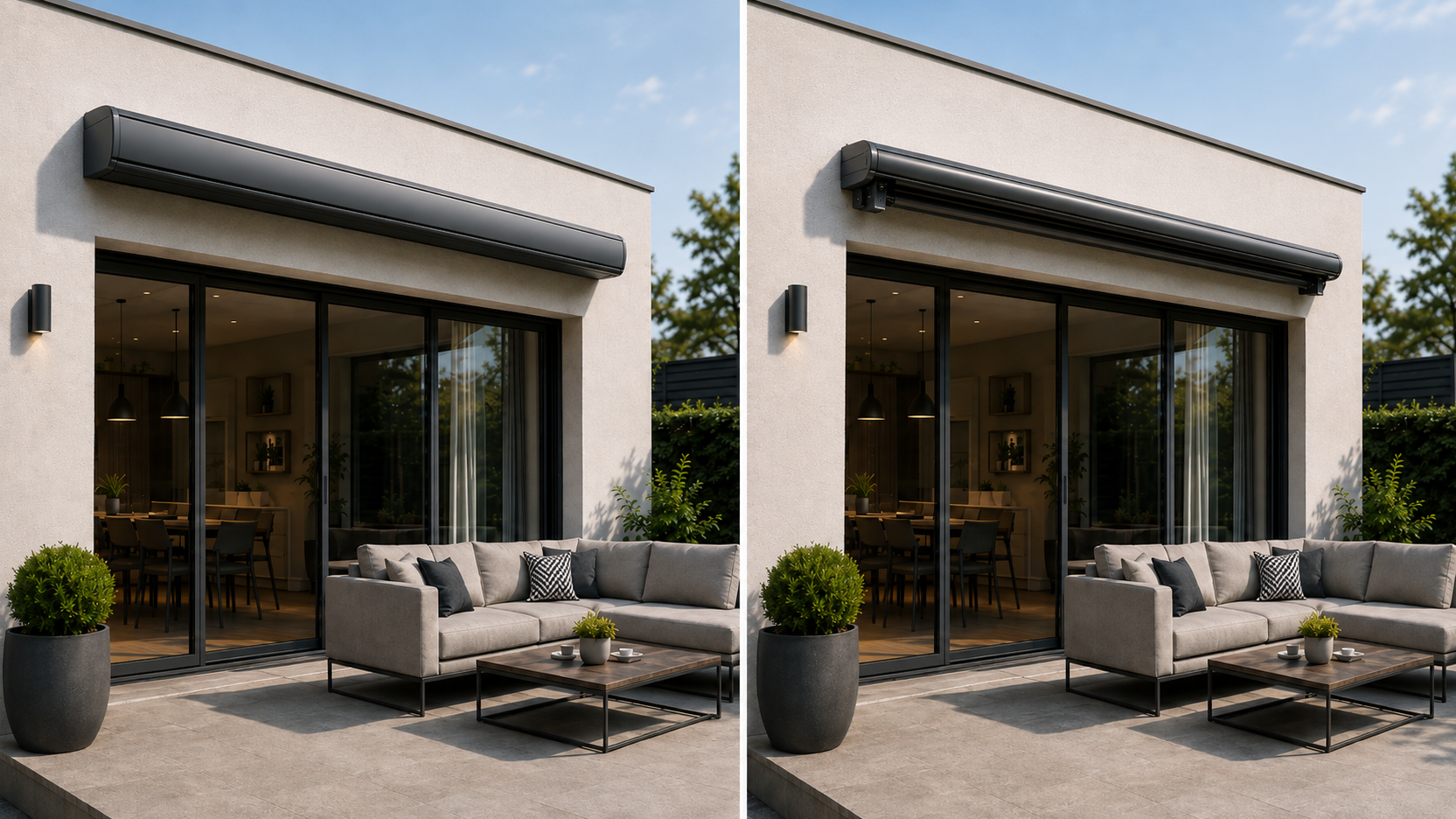
A full cassette awning encloses the fabric and folding arm mechanism within the cassette when the system is completely retracted.
Once closed, the awning forms a compact housing against the building.
This gives the system a particularly neat appearance while providing additional protection when the awning is not being used.
Benefits of a Full Cassette Awning
1. Greater Protection When Retracted
Because the fabric and mechanism are enclosed, they have less direct exposure to rain, dirt, leaves and everyday outdoor debris while the awning is closed.
This can be especially useful for installations where the awning is exposed to the elements rather than sheltered beneath an existing roofline.
2. Clean, Minimal Appearance
Full cassette awnings are popular on contemporary properties because very little of the working mechanism remains visible when the awning is retracted.
For homes with modern extensions, large areas of glazing or carefully designed exterior finishes, this discreet appearance can be an important consideration.
3. Ideal for Premium Residential Installations
Where both performance and appearance matter, a full cassette provides a highly integrated finish.
The cassette itself can also be specified to complement the exterior of the property, helping the installation feel like a considered architectural feature rather than something added afterwards.
4. Suitable for Motorisation and Automation
Modern full cassette awnings can be motorised for simple operation and combined with controls such as sun and wind sensors.
This means the awning can become a responsive part of your outdoor space rather than something that must always be operated manually.
What is a Half Cassette Awning?
A half cassette, sometimes called a semi-cassette or mini-cassette depending on the system, provides partial enclosure when the awning retracts.
The fabric is normally protected from above and can be housed securely within the cassette, while some parts of the folding arm mechanism may remain visible underneath.
This creates a system that still looks tidy and offers useful protection without fully enclosing every component.
Benefits of a Half Cassette Awning
1. Excellent for Sheltered Positions
If an awning is being installed beneath a substantial roof overhang, balcony or another protected area, a full cassette may not always be necessary.
The property itself is already providing some protection from the weather.
In these situations, a half cassette can offer an effective balance between protection and design.
2. Compact Design
Half cassette systems can have a smaller visual footprint than some fully enclosed systems.
This can make them useful where installation space is limited or where a more compact housing is preferred.
3. Flexible Choice for Different Properties
Not every installation has identical requirements.
A half cassette gives homeowners another option when a full cassette would provide more enclosure than the location actually needs.
The correct decision should therefore be based on the property rather than simply assuming that the largest cassette is automatically the best one.
Full Cassette vs Half Cassette: The Main Differences
Although both systems perform the same fundamental job, there are some important differences.
| Feature | Full Cassette | Half Cassette |
|---|---|---|
| Fabric protection when closed | Fully enclosed | Protected or partially enclosed |
| Folding arms when closed | Enclosed | May remain partly exposed |
| Appearance | Very discreet | Compact and practical |
| Best suited to | More exposed locations and premium installations | Sheltered or partially protected locations |
| Motorisation | Available | Available |
| Fabric choice | Wide range | Wide range |
| Overall protection | Maximum | Moderate to high |
There isn’t one cassette type that is automatically right for every property.
The better choice depends on where the awning will be installed and what you expect from it.
How Exposed is Your Patio?
Exposure should be one of the first things considered.
An awning positioned on an open rear elevation with little protection above it experiences very different conditions to one installed beneath a balcony.
For a more exposed installation, enclosing the system inside a full cassette when it is not being used can provide a useful additional layer of protection.
For a sheltered terrace, a half cassette may already provide everything required.
Wind exposure also matters.
The size of the awning, projection, installation height, building construction and surrounding environment should all be assessed before deciding on the final system.
This is why a professional site survey is so important when specifying a large retractable awning.
Consider How the Awning Will Look When Closed
Homeowners naturally focus on how an awning looks when it is extended.
But for much of the year, it may spend significant periods retracted.
The closed appearance therefore matters too.
A full cassette can be particularly attractive above large sliding or bifold doors because the system disappears into a slim housing once retracted, maintaining the clean lines of the rear elevation.
This is especially relevant for modern extensions where architects and homeowners have deliberately created a minimalist connection between the house and garden.
More traditional properties may offer greater flexibility, particularly where the awning is installed beneath existing architectural features.
What About Awning Fabric?
Choosing the cassette is only one part of designing the finished awning.
Fabric has an equally significant impact on the appearance of the installation.
Neutral colours such as greys, creams and darker architectural tones can allow an awning to blend naturally with contemporary properties.
Alternatively, striped or contrasting fabrics can turn the awning into a more prominent design feature.
High-quality outdoor awning fabrics are designed for regular exposure to sunlight and changing weather conditions, making the choice about more than colour alone.
The fabric should complement:
- The brickwork or exterior finish
- Window and door frames
- Garden furniture
- Patio materials
- The orientation of the property
- The amount of sunlight the area receives
Shade Space offers a wide selection of awning fabrics, allowing each installation to be tailored to the character of the property.
Should You Choose a Motorised Cassette Awning?
For many homeowners, yes.
Motorisation makes a retractable awning significantly easier to use, particularly on larger installations.
Instead of manually extending the system, the awning can be controlled at the touch of a button.
Automation can take this further.
Sun sensors can help manage shading during periods of strong sunlight, while wind sensors can respond when weather conditions change.
The result is an awning that works more naturally around how the patio and home are used throughout the day.
Which Cassette Awning is Best for a Modern Home?
For contemporary homes, a full cassette awning is often the preferred choice.
Modern properties frequently feature:
- Large bifold or sliding doors
- Rendered elevations
- Minimalist architecture
- Open-plan kitchen and dining spaces
- Carefully designed patios and landscaping
A discreet cassette allows the shading system to integrate neatly with these features.
When extended, the awning creates a comfortable shaded area outside the glazing.
When retracted, it leaves the patio open and preserves the architectural appearance of the property.
Which Cassette Awning is Best for a Traditional Home?
Traditional homes do not automatically require a traditional-looking awning.
A modern retractable system can work extremely well against period brickwork when the proportions, cassette finish and fabric are chosen carefully.
The key is designing the awning around the building.
A half cassette may suit a sheltered installation beneath an existing overhang, while a full cassette may work better where maximum protection and a cleaner closed appearance are priorities.
Colour choice becomes particularly important here.
A carefully selected fabric and cassette finish can help the installation either blend discreetly into the property or become an intentional exterior design feature.
Don’t Choose the Cassette in Isolation
One mistake homeowners can make is deciding that they want a particular awning model before the property itself has been assessed.
The cassette is only one part of the specification.
A properly designed awning should also take into account:
- Available wall width
- Required projection
- Mounting height
- Structural fixing points
- Garden orientation
- Sun position
- Wind exposure
- Doors and windows
- Intended use of the patio
- Fabric choice
- Motorisation and controls
For example, an awning designed primarily to shade a large south-facing kitchen extension may require a very different specification to one creating occasional shade above a small patio seating area.
The best results come from designing the complete system around the space.
Full Cassette or Half Cassette: Which Should You Choose?
Choose a full cassette awning if you want:
- Maximum enclosure when the awning is retracted
- A sleek and discreet appearance
- Additional protection in an exposed position
- A premium finish for a modern property
- A clean installation above large doors or glazing
Consider a half cassette awning if:
- The installation is already reasonably sheltered
- You want a compact cassette design
- Some exposure of the folding mechanism is acceptable
- The property layout makes a smaller system more appropriate
There is no need to make the decision based on terminology alone.
A site survey can establish which design provides the right balance of appearance, protection, projection and performance for your property.
Find the Right Awning for Your Outdoor Space
A well-designed retractable awning should look as though it belongs on the property.
That means choosing more than the correct fabric or colour. The cassette, dimensions, projection, controls and position of the system all need to work together.
Shade Space designs and installs bespoke retractable awnings for residential and commercial properties across London and the South East, with full cassette and compact cassette options available depending on the requirements of each space.
If you are considering a new awning for your patio, terrace or garden, book a free survey with Shade Space.
Our team can assess your property, discuss how you intend to use the space and recommend an awning specification designed around your home.